
square tops, 1969
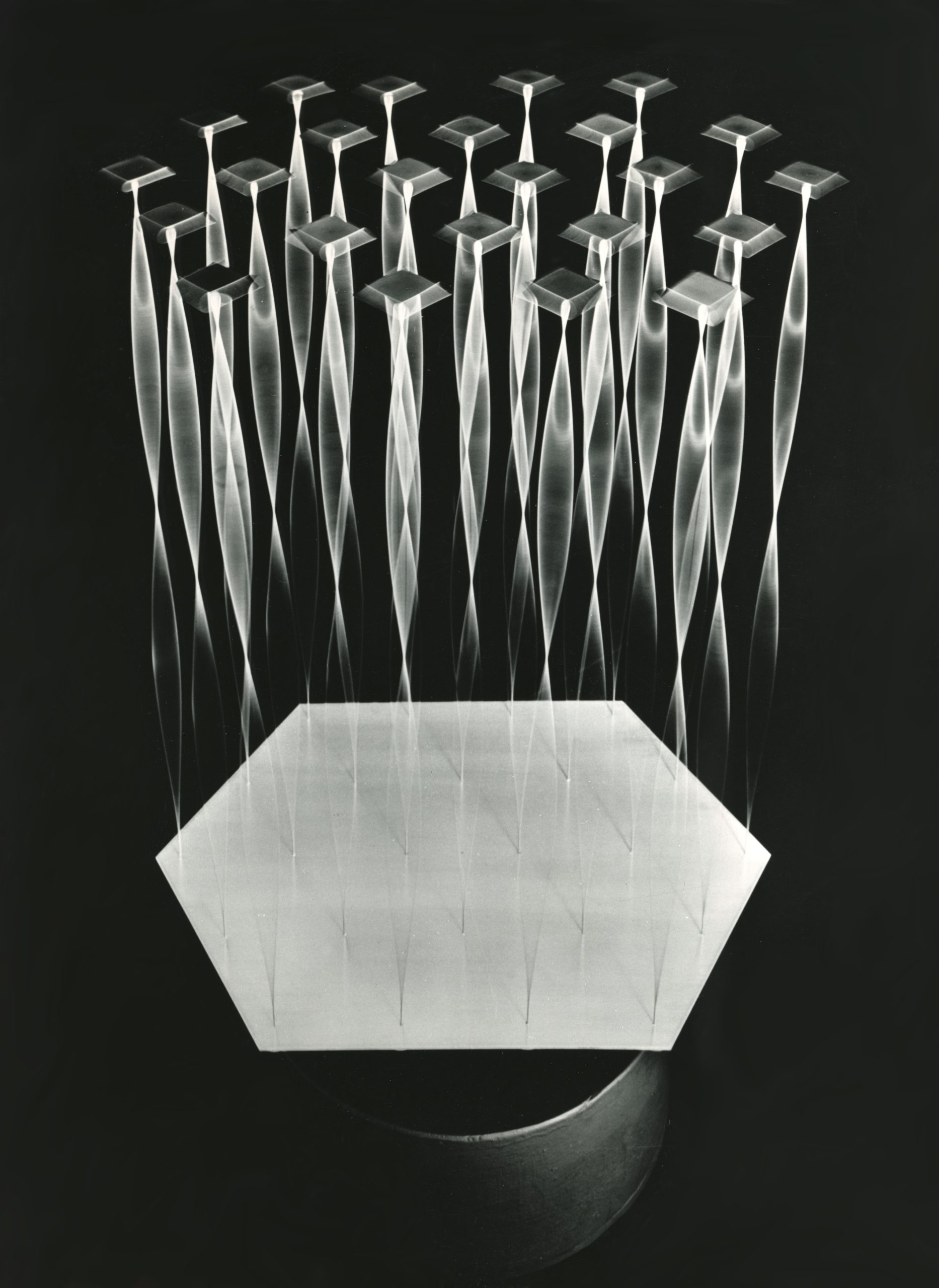
Cybernetic Sculpture No. 99 1969 is a kinetic artwork from a series of works informally titled ‘Square Tops’. Originally exhibited at the Hayden Gallery at the Massachusetts Institute of Technology in 1971, the sculpture consists of aluminium rods attached upright to a stainless-steel plate. Usually installed in a darkened room, the work is activated by an electric motor that vibrates the metal rods at a constant rate of twenty to thirty cycles per second. Flashing stroboscopic lights are set off in the gallery giving the impression that the rods are undulating and changing. Each flash lasts for a millionth of a second. The intervals between the flashes are of variable duration. When the rate of flashes is equal to the rate of vibrations, the motion appears stationary in the shape of a harmonic curve. If the rate is slower or faster, the rods appear to be undulating. Moreover, the work responds kinetically to environmental sound, such as hands clapping or people speaking, thereby changing the frequency of the strobe flashes and, ultimately, what the viewer is seeing.
As the human eye cannot perceive the transitions of the flashing strobes, the visual effect of the work depends on an afterimage. Tsai’s fellow artist and friend Otto Piene (1928–2014) described Tsai’s ‘Square Tops’ works as a ‘ghostly shimmer of dancing light threads leaving vanishing traces of metallic blue’ (Tsai 2018, p.69.), while the critic Robert Hughes stated:
The result is that when one approaches a Tsai or makes a noise in its vicinity, the thing responds. The rods appear to move; there is a shimmering, flashing, an eerie ballet of metal, whose apparent movements range from stillness to jittering, and back to a slow indescribably sensuous undulation … The rods appear to defy the laws of matter and occupy two places at the same time; or one can put a finger into an apparently empty patch of air and feel it hammered by an individual solid.
(Robert Hughes, ‘Shaped by Strobe’, Time, vol.100, no.14, 2 October 1972, http://content.time.com/time/subscriber/article/0,33009906463,00.html, accessed 4 April 2024.)
Tsai was interested in the poetic possibilities of science and technology. After a career as an engineer, he devoted his practice to experiments that fused art and science. While in residence at the MacDowell Colony in 1965 he had a breakthrough moment observing natural phenomena such as the flickering of daylight in a grove of trees which led him to work with the stroboscope. Originally used for military purposes, the stroboscopic light allowed Tsai to sculpt movement, form and visual perception in magical and surprising ways. In doing so, the artist was a frontrunner of using the latest technology of the time, continuing to experiment with fibre optics and even early digital computers, such as the Radio Shack TRS-80, in his artmaking. Piene described Tsai as ‘a grand poet writing with light of soul electronics’ (Otto Piene, ‘The Tsai Ballet: Trembling Without Fear’, in Tsai 2018, p.69).
Clara Kim
October 2021
Further reading
Tsai: Cybernetic Sculpture Environment, exhibition catalogue, Galerie Denise René, New York 1972.
Lun-Yi London Tsai (ed.), Tsai, New York 2018.